Key Performance Measures
END of KS2 Results (Y6) in 2026 ~ ( 21 children ~ so each child is ≈ 5%)
 When looking at our percentages, please remember that in a small school like ours, in each year group, a child typically represents 5% to 8%, sometimes more.
The academic year 2025/26 was another successful year, despite the challenges of falling roles nationally, and significant pupil mobility, (e.g. in-year admissions).
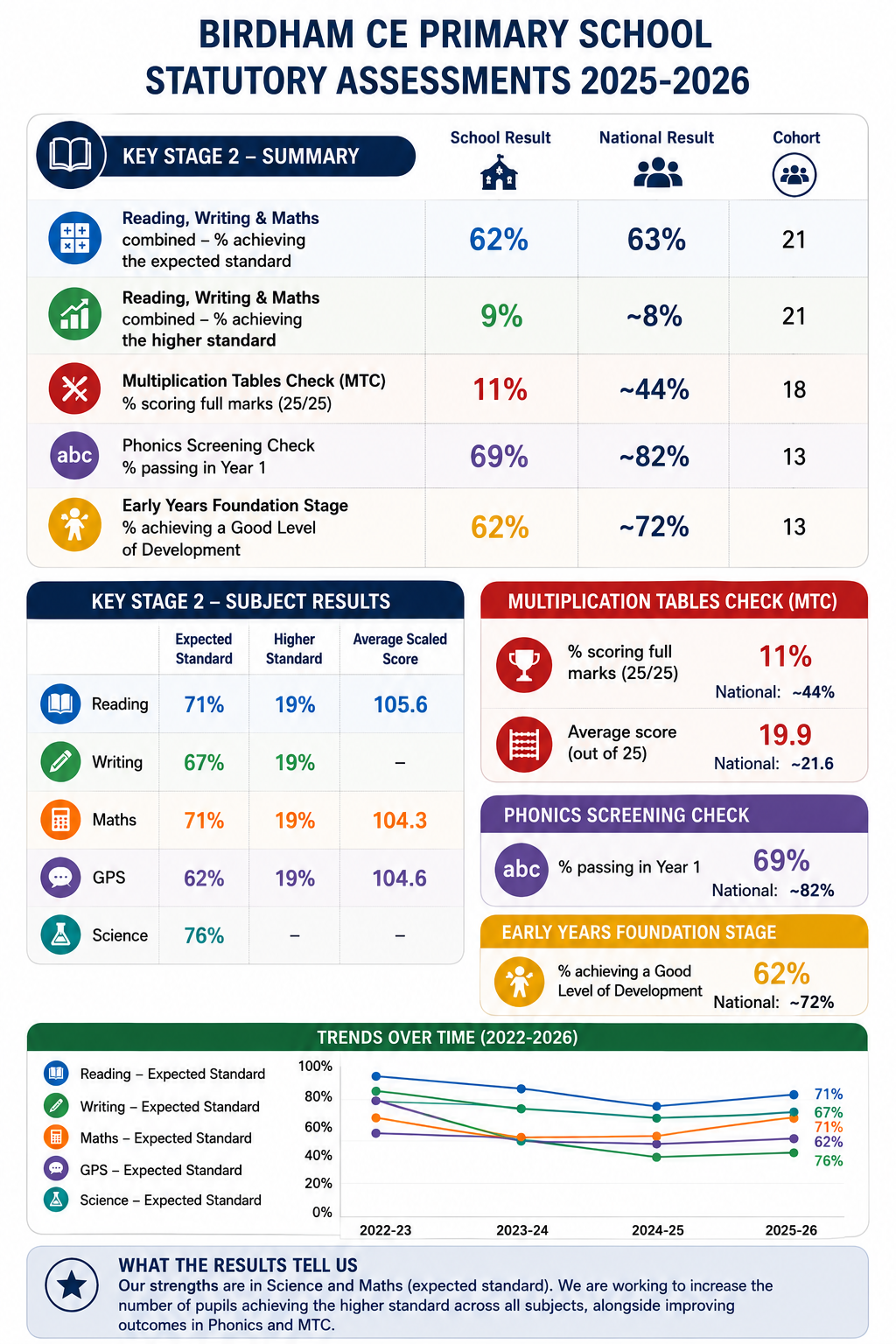
KS2 results at ARE+ in 2026 were largely as expected, with almost all metrics being either broadly in line with national, or just one child below national; so nothing here is considered to be statistically very significant. Individual children will continue to receive personalised interventions to help overcome any learning barriers. Only our GPS results was outside this range, being two children below national. Our Reading, Writing and Maths combined figure of 62% ARE+ was pleasingly in line with national at 63%.
 At GDS, writing and RWM combined were pleasingly also above or in line with national.
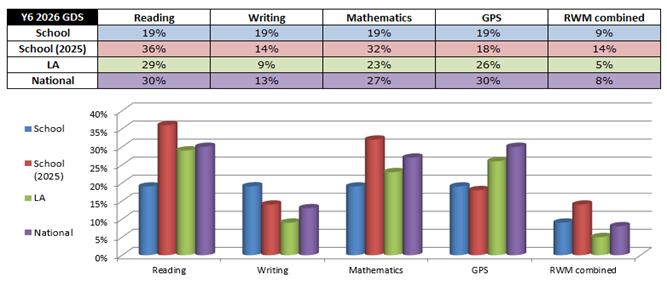
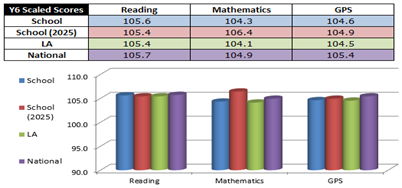
Another measure that the DfE ask schools to monitor is that of scaled scores. All our Scaled scores were also very closely in line with national with no major concerns identified.
 These results are especially pleasing as four children joined Y6 during spring or summer terms of Y6.
All these results need to be interpreted in the context of our very small cohort, where individual pupils have a substantial effect on percentages, and significant pupil mobility during the year: e.g. Four pupils joined Year 6 during the spring or summer terms.
multiplication tables check (Y4) in 2026 ~ (18 children ~ so each child is ≈ 6%)
MTC outcomes improved substantially compared with 2024/25 but remained below national on the headline measure. The impact of the two pupils who joined during the spring and summer terms should be considered when interpreting the cohort's results. Among the remaining 16 pupils, 7 (44%) scored 24 or more, which is exactly in line with national.
The improvement is encouraging, but the headline result remains an area for development. Leaders will continue to prioritise multiplication-table fluency from Year 2 onwards, with teaching and assessment used to identify pupils who need additional practice and to evaluate whether this provision improves fluency and eventual MTC outcomes.
PHONICS (Y1) in 2026 ~ (13 children ~ so each child is ≈ 8%)
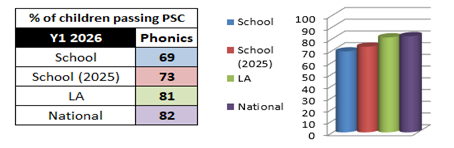
This result is about one child below national. However. our high quality phonics teaching ensured as many of our children as possible in this very small cohort reached the PSC threshold (this year it was reduced to 31 from 32).
- All children who we expected to pass the PSC, did so.
- Of the remaining four children, three will require significantly different approaches to support their unique challenges, including the two with significant SEND.
EYFS (reception) in 2026 ~ (13 children ~ so each child is ≈ 8%)
The proportion of children achieving a Good Level of Development (GLD) was 62%, compared with 72% nationally and 57% in 2025. The outcome represents an improvement on the previous year's result, although it remains one child below national.
The cohort had a higher-than-usual starting profile in the autumn term, when the initial assessment indicated 72%. Two children subsequently joined later in the year, affecting the final cohort profile and outcome.

WHOLE SCHOOL SUMMARY for 2025/26 FROM THIS DATA
- Almost every KPM was either in line with national or just one child below, despite a significantly high pupil mobility this academic year
- The Y4 MTC remains a significant outlier in our performance, despite a large improvement on last year; however, if all children scoring 24/25 had scored 25, we would be exactly in line with national
- Our Phonics provision remains effective, however those repeating the PSC in Y2 will need a different provision to succeed
- Despite their being no statutory assessments in KS1, it is this cohort that is our main focus for intervention. As such Pupil Progress Meetings in Sep-26 will identify strategies to support these groups of children
ARE means working at Age Related Expectations.
GDS means working at Greater Depth within the Standard.
GPS refers to an English test on Grammar, Punctuation and Spelling.
RWM Combined means those pupils achieving a pass or better in Reading and Writing and Mathematics
Scaled Scores convert pupils actual test scores into a ranking system, whereby 100 is considered the average pass mark.
A SUMMARY GRApHIC FOR THEN 2025-26 :
KEEPING PARENTS WELL INFORMED ...
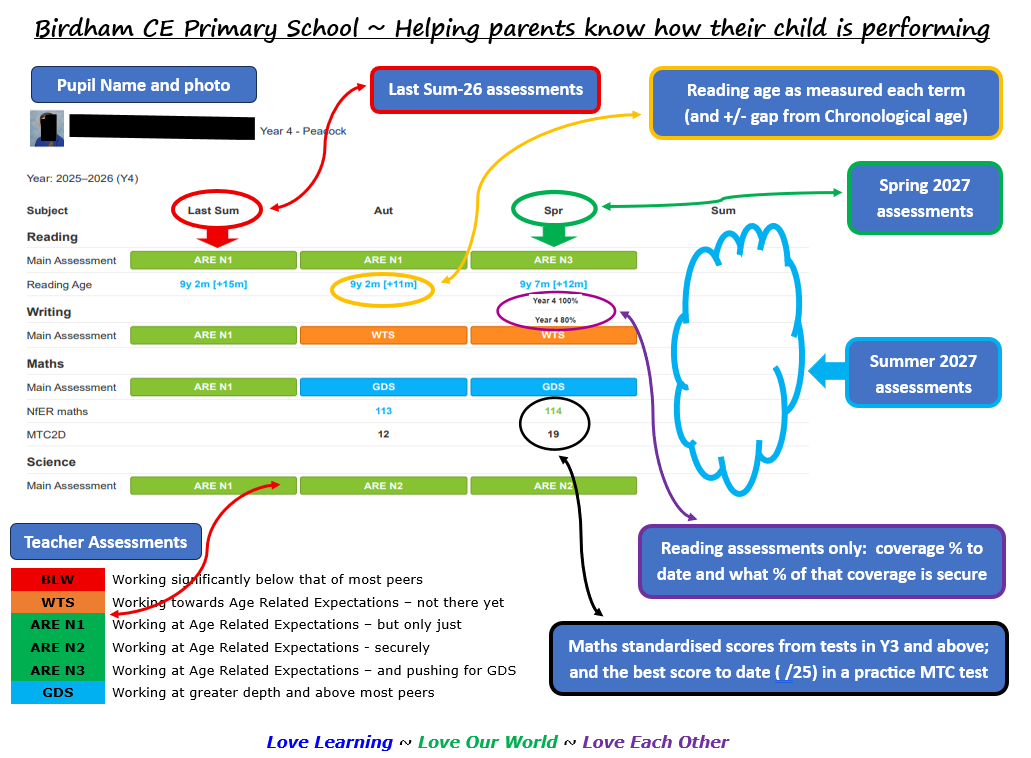
We like to keep our parents as well informed as possible. As such, if we measure any learning, we will communicate it with you. Typically we do not like to assess very young children formally - we assess by watching they learn through play - but for older children, in Y3 and above, we will formally assess children and provide you with termly information at parents evenings. Here is an example of the sort of data we might share. Do not worry if it looks complicated, teachers will explain it all and you will soon get the hang of it.